An operator $\hat{A}$ is Hermitian if $\hat{A}^\dagger = \hat{A}$.
- The operator $\frac{\hbar}{\text{i}} \frac{\text{d}}{\text{d}x} = \hat{p}_x$ is the momentum operator, which is Hermitian.
- The second derivative operator $\frac{\text{d}^2}{\text{d}x^2}$ is Hermitian because $\left(\frac{\text{d}^2}{\text{d}x^2}\right)^\dagger = \frac{\text{d}^2}{\text{d}x^2}$.
- Therefore, $\left(\text{i} \frac{\text{d}^2}{\text{d}x^2}\right)^\dagger = -\text{i} \left(\frac{\text{d}^2}{\text{d}x^2}\right)^\dagger = -\text{i} \frac{\text{d}^2}{\text{d}x^2} \neq \text{i} \frac{\text{d}^2}{\text{d}x^2}$. Thus, it is anti-Hermitian, not Hermitian.
- $x^2$ is a real multiplicative operator, which is Hermitian.
Hence, $\text{i}\frac{\text{d}^2}{\text{d}x^2}$ is not Hermitian.
Q22mcq
The term symbol for the ground state of nitrogen atoms is
a.
$^3\text{P}_0$
b.
$^4\text{P}_{3/2}$
c.
$^1\text{P}_1$
d.
$^4\text{S}_{3/2}$
Correct Answer
Step-by-Step AI Explanation
Verified Method
The electronic configuration of a nitrogen atom ($Z = 7$) in its ground state is $1s^2 2s^2 2p^3$.
For the three electrons in the $2p$ subshell ($m_l = +1, 0, -1$):
- Total spin $S = \frac{1}{2} + \frac{1}{2} + \frac{1}{2} = \frac{3}{2}$, so the spin multiplicity is $2S + 1 = 2\left(\frac{3}{2}\right) + 1 = 4$.
- Total orbital angular momentum quantum number $L = \sum m_l = (+1) + (0) + (-1) = 0$, which corresponds to an $\text{S}$ term.
- Total angular momentum quantum number $J = |L - S| = |0 - 3/2| = 3/2$.
Therefore, the ground state term symbol is $^4\text{S}_{3/2}$.
Q23mcq
$\text{P}_\text{A}$ and $\text{P}_\text{B}$ denote the populations of two energy states $\text{E}_\text{A}$ and $\text{E}_\text{B}$, and $\text{E}_\text{A} > \text{E}_\text{B}$ The correct statment when the temperature $\text{T}_1 > \text{T}_2$ is
According to the Boltzmann distribution law, the ratio of populations of two states of energies $E_A$ and $E_B$ with equal degeneracies is given by:
$$\frac{P_A}{P_B} = \exp\left(-\frac{E_A - E_B}{k_B T}\right)$$
Since $E_A > E_B$, the exponent is negative, so for any finite temperature $T > 0$, we have:
$$P_A < P_B$$
Thus, $P_A(T_1) < P_B(T_1)$ and $P_A(T_2) < P_B(T_2)$.
Furthermore, as temperature increases ($T_1 > T_2$), the magnitude of $\frac{E_A - E_B}{k_B T}$ decreases, causing $\exp\left(-\frac{E_A - E_B}{k_B T}\right)$ to increase towards 1. Therefore:
$$\left(\frac{P_A}{P_B}\right)_{T_1} > \left(\frac{P_A}{P_B}\right)_{T_2}$$
This matches option C.
Q24mcq
The uncertainty in the NMR frequency of a compound in liquid state (relaxation time $= 1\text{ s}$) is $0.1\text{ Hz}$. The uncertainty in the frequency (in Hz) of same compound in solid state (relaxation time $= 10^{-4}\text{ s}$) is
a.
$10^{-4}$
b.
$100$
c.
$1000$
Correct Answer
d.
$10^{-3}$
Step-by-Step AI Explanation
Verified Method
From the energy-time uncertainty principle, the uncertainty in frequency $\Delta \nu$ is inversely proportional to the relaxation time (lifetime) $\tau$, i.e., $\Delta \nu \propto \frac{1}{\tau}$.
Therefore:
$$\frac{\Delta \nu_2}{\Delta \nu_1} = \frac{\tau_1}{\tau_2}$$
Given $\tau_1 = 1\text{ s}$, $\Delta \nu_1 = 0.1\text{ Hz}$, and $\tau_2 = 10^{-4}\text{ s}$:
$$\Delta \nu_2 = 0.1 \times \frac{1}{10^{-4}} = 0.1 \times 10^4 = 1000\text{ Hz}$$
Q25mcq
Which one of the following conductometric titrations will show a linear increase of the conductance with volume of the titrant added up to the break point and an almost constant conductance afterwards.
a.
A strong acid with a strong base
b.
A strong acid with a weak base
c.
A weak acid with a strong base
d.
A weak acid a weak base.
Correct Answer
Step-by-Step AI Explanation
Verified Method
In the titration of a weak acid (e.g., $\text{CH}_3\text{COOH}$) with a weak base (e.g., $\text{NH}_4\text{OH}$):
- Initially, the conductance of the weak acid is very low due to poor dissociation.
- Addition of the weak base forms a highly ionized salt (e.g., $\text{CH}_3\text{COONH}_4$), which increases the number of conducting ions linearly up to the equivalence point.
- Beyond the equivalence point, further addition of the weak base contributes negligibly to conductivity because the excess weak base is weakly dissociated and its ionization is suppressed by the common ion effect.
Thus, the conductance increases linearly up to the break point and remains almost constant afterwards.
Q26mcq
Flocculation value of $\text{K}_2\text{SO}_4$ is much less than that of $\text{KBr}$ for Sol A. Floccultion value of $\text{CaCl}_2$ is much less than that of $\text{NaCl}$ for Sol B. Which of the following statements is correct ?
a.
Sol A is negatively charged and Sol B is positively charged
b.
Both the sols are negatively charged.
c.
Sol A is positively charged and sol B is negatively charged
Correct Answer
d.
Both the sols are positively charged.
Step-by-Step AI Explanation
Verified Method
According to the Hardy-Schulze rule:
- The coagulating/flocculating power of an electrolyte is directly proportional to the valency of the active ion (the ion carrying charge opposite to that of the colloidal particles).
- Flocculation value is inversely proportional to coagulating power, so an ion with higher valency has a much lower flocculation value.
For Sol A:
$\text{K}_2\text{SO}_4$ provides $\text{SO}_4^{2-}$ (divalent anion) and $\text{KBr}$ provides $\text{Br}^-$ (monovalent anion). Since the flocculation value of $\text{K}_2\text{SO}_4$ is much less than that of $\text{KBr}$, the effective ion is the anion. Hence, Sol A is positively charged.
For Sol B:
$\text{CaCl}_2$ provides $\text{Ca}^{2+}$ (divalent cation) and $\text{NaCl}$ provides $\text{Na}^+$ (monovalent cation). Since the flocculation value of $\text{CaCl}_2$ is much less than that of $\text{NaCl}$, the effective ion is the cation. Hence, Sol B is negatively charged.
Q27mcq
For a system of constant composition, the pressure (P) is given by.
The fundamental thermodynamic relation for internal energy $U$ in a closed system of constant composition is:
$$\text{d}U = T\text{d}S - P\text{d}V$$
From this equation, taking the partial derivative of $U$ with respect to volume $V$ at constant entropy $S$ gives:
$$P = -\left(\frac{\partial U}{\partial V}\right)_S$$
Q28mcq
The value of $\text{d}_{111}$ in a cubic crystal is $325.6\text{ pm}$. The value of $\text{d}_{333}$ is
a.
$325.6\text{ pm}$
b.
$976.8\text{ pm}$
c.
$108.5\text{ pm}$
Correct Answer
d.
$625.6\text{ pm}$
Step-by-Step AI Explanation
Verified Method
For a cubic crystal with lattice parameter $a$, the interplanar spacing $d_{hkl}$ is given by:
$$d_{hkl} = \frac{a}{\sqrt{h^2 + k^2 + l^2}}$$
For the $(111)$ planes:
$$d_{111} = \frac{a}{\sqrt{1^2 + 1^2 + 1^2}} = \frac{a}{\sqrt{3}} = 325.6\text{ pm}$$
For the $(333)$ planes:
$$d_{333} = \frac{a}{\sqrt{3^2 + 3^2 + 3^2}} = \frac{a}{\sqrt{27}} = \frac{a}{3\sqrt{3}} = \frac{d_{111}}{3}$$
Therefore:
$$d_{333} = \frac{325.6}{3} \approx 108.53\text{ pm} \approx 108.5\text{ pm}$$
Q29mcq
The symmetry point group of ethane in its staggered conformation is
a.
$\text{C}_{3\text{v}}$
b.
$\text{D}_{3\text{d}}$
Correct Answer
c.
$\text{D}_{3\text{h}}$
d.
$\text{S}_6$
Step-by-Step AI Explanation
Verified Method
Ethane in its staggered conformation possesses a $C_3$ principal rotational axis along the $\text{C}-\text{C}$ bond, three perpendicular $C_2$ axes bisecting the $\text{H}-\text{C}-\text{C}-\text{H}$ dihedral angles, three dihedral mirror planes ($\sigma_d$), an inversion center ($i$), and an alternating axis of symmetry $S_6$. Thus, its symmetry point group is $\text{D}_{3\text{d}}$.
Q30mcq
For the reaction $\text{C}_2\text{H}_4(\text{g}) + 3\text{O}_2(\text{g}) \rightarrow 2\text{CO}_2(\text{g}) + 2\text{H}_2\text{O}(\ell)$, the value of $\Delta\text{H} - \Delta\text{U}$ (in kJ) at $300\text{ K}$ and $1\text{ bar}$ is
a.
$-5.0$
Correct Answer
b.
$0.0$
c.
$2.5$
d.
$5.0$
Step-by-Step AI Explanation
Verified Method
The relationship between enthalpy and internal energy changes is given by:
$$\Delta H - \Delta U = \Delta n_g RT$$
For the reaction:
$$\text{C}_2\text{H}_4(\text{g}) + 3\text{O}_2(\text{g}) \rightarrow 2\text{CO}_2(\text{g}) + 2\text{H}_2\text{O}(\ell)$$
$$\Delta n_g = n_g(\text{products}) - n_g(\text{reactants}) = 2 - (1 + 3) = -2$$
Substituting the values with $R = 8.314\text{ J K}^{-1}\text{ mol}^{-1}$ and $T = 300\text{ K}$:
$$\Delta H - \Delta U = (-2) \times 8.314 \times 300\text{ J} = -4988.4\text{ J} \approx -5.0\text{ kJ}$$
🎉 10 Free Sample Solutions Completed
Unlock All 125 Questions & Solutions
Sign up free in seconds to unlock step-by-step AI answers for the remaining 115 questions.
The sodium D lines are due to ${^2}\text{P}_{1/2} \rightarrow {^2}\text{S}_{1/2}\ (\Delta\text{E}_1)$ and ${^2}\text{P}_{3/2} \rightarrow {^2}\text{S}_{1/2}\ (\Delta\text{E}_2)$ transitions. The splitting due to spin-orbit coupling in ${^2}\text{P}$ state of the sodium atom is
a.
$\Delta\text{E}_2 + \Delta\text{E}_1$
b.
$\Delta\text{E}_2 - \Delta\text{E}_1$
c.
$\frac{\Delta\text{E}_2 + \Delta\text{E}_1}{2}$
d.
$\frac{\Delta\text{E}_2 - \Delta\text{E}_1}{2}$
Correct Answer & Step-by-Step Solution Locked
Sign in free to reveal the correct answer and AI explanation for this question.
The rate constant of a unimolecular reaction was $2.66\times10^{-3}\text{ s}^{-1}$ and $2.2\times10^{-1}\text{ s}^{-1}$ at $\text{T} = 120\text{K}$ and $360\text{ K}$ respectively. The rate constant (in $\text{s}^{-1}$ units) at $240\text{ K}$ would be
a.
$2.4\times10^{-2}$
b.
$2.4\times10^{-1}$
c.
$4.8\times10^{-2}$
d.
$1.8\times10^{-3}$
Correct Answer & Step-by-Step Solution Locked
Sign in free to reveal the correct answer and AI explanation for this question.
The osmotic pressure $(\pi)$ of a polymer sample at different concentrations (c) was measured at $\text{T}(\text{K})$. A plot of $(\pi/\text{c})$ versus $\text{c}$ gave a straight line with slope $(\text{m})$ and intercept $(\text{c}')$. The number average molecular weight of the ploymer is ($\text{R} = \text{gas constant}$).
a.
$\frac{\text{Rt}}{\text{c}'}$
b.
$\frac{\text{c}'}{\text{RT}}$
c.
$\text{RT}$
d.
$\text{mRT}$
Correct Answer & Step-by-Step Solution Locked
Sign in free to reveal the correct answer and AI explanation for this question.
The concentration of a reactant undergoing decomposition was $0.1$, $0.08$ and $0.067\text{ mol L}^{-1}$ after $1.0$, $2.0$ and $3.0\text{ hr}$ respectively. The order of the reaction is
a.
$0$
b.
$1$
c.
$2$
d.
$3$
Correct Answer & Step-by-Step Solution Locked
Sign in free to reveal the correct answer and AI explanation for this question.
A particle is constrained in a one dimensional box of length $2\text{a}$ with potential $\text{V}(\text{x}) = \infty;\ \text{x} < -\text{a}, \text{x} > \text{a}$ and $\text{V}(\text{x}) = 0;\ -\text{a} \le \text{x} \le \text{a}$. Energy difference between levels $\text{n} = 3$ and $\text{n} = 2$ is
a.
$\frac{5\text{h}^2}{8\text{ma}^2}$
b.
$\frac{9\text{h}^2}{8\text{ma}^2}$
c.
$\frac{9\text{h}^2}{32\text{ma}^2}$
d.
$\frac{5\text{h}^2}{32\text{ma}^2}$
Correct Answer & Step-by-Step Solution Locked
Sign in free to reveal the correct answer and AI explanation for this question.
The correct combination of metal, number of carbonyl ligands and the charge for a metal carbonyl complex $\left[\mathrm{M}(\mathrm{CO})_x\right]^{z-}$ that satisfies the 18 electron rule is
a.
$\mathrm{M} = \mathrm{Ti}, x = 6, z = 1$
b.
$\mathrm{M} = \mathrm{V}, x = 6, z = 1$
c.
$\mathrm{M} = \mathrm{Co}, x = 4, z = 2$
d.
$\mathrm{M} = \mathrm{Mo}, x = 5, z = 1$
Correct Answer & Step-by-Step Solution Locked
Sign in free to reveal the correct answer and AI explanation for this question.
Among the following pairs
(1) oxygen-sulfur
(2) nitrogen -phosphorus
(3) phosphorus arsenic
(4) chlorine- iodine
Those in which the first ionization energies differ by more than $300\text{ kJ mole}^{-1}$ are :
a.
(1) and (3) only
b.
(1) and (2) only
c.
(2) and (3) only
d.
(3) and (4) only
Correct Answer & Step-by-Step Solution Locked
Sign in free to reveal the correct answer and AI explanation for this question.
Two $\alpha$ particles having speeds $\mathrm{S}_1$ and $\mathrm{S}_2$ have kinetic energies $1$ and $2\text{ MeV}$ respectively; the relationship between $\mathrm{S}_1$ and $\mathrm{S}_2$ is :
a.
$\mathrm{S}_1 = 2\mathrm{S}_2$
b.
$\mathrm{S}_2 = 2\mathrm{S}_1$
c.
$\mathrm{S}_2 = \sqrt{2}\ \mathrm{S}_1$
d.
$\mathrm{S}_1 = \sqrt{2\mathrm{S}_2}$
Correct Answer & Step-by-Step Solution Locked
Sign in free to reveal the correct answer and AI explanation for this question.
Green coloured $\text{Ni(PPh}_2\text{Et)}_2\text{Br}_2$, has a magnetic moment of 3.20 B.M. The geometry and the number of isomers possible for the complex respectively, are
a.
square planar and one
b.
tetrahedral and one
c.
Square planer and two
d.
tetrahedral and two
Correct Answer & Step-by-Step Solution Locked
Sign in free to reveal the correct answer and AI explanation for this question.
The chemiluminescence method for determining NO in environmental samples is based on formation of $\text{NO}_2^*$ (excited) which is generally generated by reacting NO with
a.
$\text{O}_2$
b.
$\text{O}_2^-$
c.
$\text{O}_3$
d.
$\text{O}_2^{2-}$
Correct Answer & Step-by-Step Solution Locked
Sign in free to reveal the correct answer and AI explanation for this question.
An organic compound (MF: $\text{C}_8\text{H}_{10}\text{O}$) exhibited the following $^1\text{H}$ NMR spectral data : $\delta$ 2.5 (3 H,s), 3.8 (3H, s), 6.8 (2 H, d, J = 8=Hz), 7.2 (2 H, d, J=8 Hz) ppm. The compound among the choices, is
a.
4-ethylphenol
b.
2-ethylphenol
c.
4-methylanisole
d.
4-methylbenzyl alcohol
Correct Answer & Step-by-Step Solution Locked
Sign in free to reveal the correct answer and AI explanation for this question.
Consider a n-type semiconductor whose $\text{E}_\text{v} = 0, \text{E}_\text{c} = 2.0\text{eV}$ and $\text{E}_\text{d} = 1.98\text{eV}$. The correct statement among the following is
a.
$\text{E}_\text{f} = 1\text{eV}$ and is independent of T
b.
$\text{E}_\text{f} = 1.99\text{ eV}$ and remains independent of T
c.
$\text{E}_\text{f} = 1.99\text{ eV}$ and increases towards $2.0\text{ eV}$ with increase of T
d.
$\text{E}_\text{f} = 1.99\text{ eV}$ and decreases with increase of T.
Correct Answer & Step-by-Step Solution Locked
Sign in free to reveal the correct answer and AI explanation for this question.
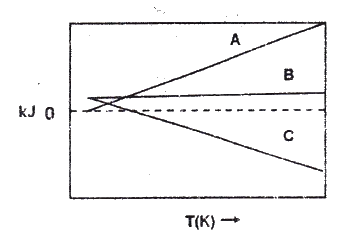
For the reaction $\text{H}_2\text{O}(\text{g}) + \text{C}(\text{graphite}) \rightleftharpoons \text{CO}(\text{g}) + \text{H}_2\text{O}(\text{g})$, the variation of energy parameter $\Delta\text{G}^\circ$, $\Delta\text{H}^\circ$ and $\text{T}\Delta\text{S}^\circ$ of the reaction over a large temperature range is shown below. The correct identification of the curves is given by
Two moles of a nonvolatile solute is dissolved in $48\text{ mol}$ of water and the resultant solution has a vapour pressure of $0.0392\text{ bar}$ at $300\text{ K}$. If the vapour pressure of pure water at $300\text{ K}$ is $0.0400\text{ bar}$, the activity coefficient of water in the solution is:
a.
$0.96$
b.
$0.98$
c.
$1.00$
d.
$1.02$
Correct Answer & Step-by-Step Solution Locked
Sign in free to reveal the correct answer and AI explanation for this question.
$1\text{ mol}$ of $\text{CO}_2$, $1\text{ mol}$ of $\text{N}_2$ and $2\text{ mol}$ of $\text{O}_2$ were mixed at $300\text{ K}$. The entropy of mixing is
a.
$6\text{ R}\ln 2$
b.
$8\text{ R}\ln 2$
c.
$\frac{8\text{ R}\ln 2}{300}$
d.
$16\text{R}\ln 2$
Correct Answer & Step-by-Step Solution Locked
Sign in free to reveal the correct answer and AI explanation for this question.
For the eigenstates of the hydrogen atom, which of the following relations between the expectation value of kinetic energy (T) and potential (V) holds true ?
For the liquid $\rightleftharpoons$ vapour equilibrium of a substance $\frac{\text{dP}}{\text{dT}}$ at $1\text{ bar}$ and $400\text{ K}$ is $8 \times 10^{-3}\text{ bar }\text{K}^{-1}$. If the molar volume in the vapour form is $200\text{ L}\text{ mol}^{-1}$ and the molar volume in the liquid form is negligible, the molar enthalpy of vapourisation is ($1.0\text{ bar}\text{ L} = 100\text{ J}$)
a.
$640\text{ kJ}\text{ mol}^{-1}$
b.
$100\text{ kJ}\text{ mol}^{-1}$
c.
$80\text{ kJ}\text{ mol}^{-1}$
d.
$64\text{ kJ}\text{ mol}^{-1}$
Correct Answer & Step-by-Step Solution Locked
Sign in free to reveal the correct answer and AI explanation for this question.
The Langmuir adsorption isotherm is given by $\theta = \frac{\mathrm{Kp}}{1 + \mathrm{Kp}}$, where $\mathrm{P}$ is the pressure of the adsorabate gas. The Langmuir adsorption isotherm for a diatomic gas $\mathrm{A}_2$ undergoing dissociative adsorption is:
The standrad electrode potentials ($\mathrm{E}^0$) of $\mathrm{Fe}^{3+}/\mathrm{Fe}^{2+}$ and $\mathrm{Fe}^{2+}/\mathrm{Fe}$ electrodes are $+0.77\text{ V}$ and $-0.44\text{ V}$ respectively at $300\text{ K}$. The $\mathrm{E}^0$ of $\mathrm{Fe}^{3+}/\mathrm{Fe}$ electrode at the same temperature is
a.
$1.21\text{ V}$
b.
$0.33\text{ V}$
c.
$-0.11\text{ V}$
d.
$-0.04\text{ V}$
Correct Answer & Step-by-Step Solution Locked
Sign in free to reveal the correct answer and AI explanation for this question.
Which of the following is true for the radial part of the hydrogen atom wavefunctions $\mathrm{R}_{n\ell}(r)$ ($n$ principal quantum number) and the nodes associated with them?
a.
The radial part of only s function is non-zero at the origin and has $(n - 1)$ nodes.
b.
The radial part of s function is zero at the origin and has $n$ number of nodes.
c.
All radial functions have values of zero at the origin and have $(n - 1)$ nodes.
d.
The radial parts of all s functions are zero at the origin and have no nodes.
Correct Answer & Step-by-Step Solution Locked
Sign in free to reveal the correct answer and AI explanation for this question.
For non-degenerate perturbation theory for ground state, with $\mathrm{E}_0^{(0)}$ as zeroth order energy, $\mathrm{E}_0^{(1)}$ as the first-order perturbation correction and $\mathrm{E}_0$ as the exact energy, which of the following is true?
a.
$(\mathrm{E}_0^{(0)} + \mathrm{E}_0^{(1)})$ is always equal to $\mathrm{E}_0$
Observe the following electronic transition of a diatomic molecule.
(A) ${}^1\Sigma^+ \to {}^3\Sigma_g^+$
(B) ${}^1\Sigma_u^+ \to {}^1\Sigma_g^+$
(C) ${}^1\Delta_u \to {}^1\Sigma_g^+$
(D) ${}^1\Pi_g \to {}^1\Sigma_u^+$
The allowed transitions are
a.
(A) and (C) only
b.
(B) and (D) only
c.
(A), (B) and (C) only
d.
(A), (C) and (D) only
Correct Answer & Step-by-Step Solution Locked
Sign in free to reveal the correct answer and AI explanation for this question.
An excited triplet state wave function of hydrogen molecule with the electronic configuration $\sigma_{\mathrm{g}}^1 \sigma_{\mathrm{u}}^1$ has the following space part
The NMR spectrum of $\mathrm{AX}_3$ exhibits lines at $\delta = 2.1$ and $2.3\text{ ppm}$ (for $\mathrm{X}$ type protons) and $\delta = 4.1, 4.3, 4.5$ and $4.7\text{ ppm}$ (for $\mathrm{A}$ type protons), measured from TMS with an instrument operating at $100\text{ MHz}$. The chemical shift (in ppm) of $\mathrm{A}$ and $\mathrm{X}$ protons and coupling constant (in Hz) are respectively.
a.
$4.4$, $2.2$ and $20$
b.
$2.2$, $4.4$ and $10$
c.
$2.2$, $4.4$ and $5$
d.
$4.3$, $2.1$ and $20$
Correct Answer & Step-by-Step Solution Locked
Sign in free to reveal the correct answer and AI explanation for this question.
The character table of the $\mathrm{C}_{2\mathrm{v}}$ point group is given below:
The two functions $\varphi_1 = \mathrm{p}_1 + 2\mathrm{p}_2 + 2\mathrm{p}_3 + \mathrm{p}_4$ and $\varphi_2 = 2\mathrm{p}_1 - \mathrm{p}_2 - \mathrm{p}_3 + 2\mathrm{p}_4$ (where $\mathrm{p}_k$ is the p-orbital on the $k^{\text{th}}$ atom of cis-butadiene and $\sigma_v$ is the molecular plane) belong to
a.
$\mathrm{A}_1$ and $\mathrm{A}_2$ respectively
b.
Both $\mathrm{A}_2$
c.
Both $\mathrm{B}_2$
d.
$\mathrm{B}_1$ and $\mathrm{B}_2$ respectively.
Correct Answer & Step-by-Step Solution Locked
Sign in free to reveal the correct answer and AI explanation for this question.
If $\theta_r$ denotes the characteristic tempreture of rotation then the magnitude of $\left[\theta_r(\mathrm{H}_2)\theta_r(\mathrm{D}_2)\right]/\left[\theta_r(\mathrm{HD})\right]^2$ (assume the bond lengths to be the same for all the molecules ) is
a.
$2/3$
b.
$3/2$
c.
$8/9$
d.
$9/8$
Correct Answer & Step-by-Step Solution Locked
Sign in free to reveal the correct answer and AI explanation for this question.
The overall reaction for the passage of $1.0\text{ faraday}$ of charge in the following cell
$$\mathrm{Ag(s)} - \mathrm{AgCl(s)} | \mathrm{KCl}(a_1) | \mathrm{KCl}(a_2) | \mathrm{AgCl(s)} - \mathrm{Ag(s)}$$
is given by (t denotes the transport numbers)
A system consisting of 4 identical and distinguishable particle , each possessing three available states of 1, 2 and 3 units, has 10 units of energy. The number of ways, W, in which these conditions are satisfied is
a.
2
b.
4
c.
6
d.
10
Correct Answer & Step-by-Step Solution Locked
Sign in free to reveal the correct answer and AI explanation for this question.
The molar conductivities at infinite dilution $\Lambda_{\mathrm{m}}^0$ for $\mathrm{Na_2SO_4}, \mathrm{K_2SO_4}, \mathrm{KCl}, \mathrm{HCl}$ and $\mathrm{HCOONa}$ at $300\text{ K}$ are $260$, $308$, $150$, $426$ and $105\text{ S cm}^{-1}\text{ mol}^{-2}$ respectively. Hence $\Lambda_{\mathrm{m}}^0$ for formic acid in the same unit and at the same temperature is
a.
381
b.
405
c.
429
d.
531
Correct Answer & Step-by-Step Solution Locked
Sign in free to reveal the correct answer and AI explanation for this question.
If the displacement vectors of all atoms in cis-butadiene are taken as the basis vectors the characters of the reducible representation of $E$, $C_2$, $\sigma_v$ (molecular plane) and $\sigma_v'$ are
a.
30, 10, 30, 0
b.
30, 0, 10, 0
c.
30, 20, 0, 0
d.
30, 0, 20, 0
Correct Answer & Step-by-Step Solution Locked
Sign in free to reveal the correct answer and AI explanation for this question.
At any temperature for the following reaction (D and T are deuterium and tritium respectively) correct statement is:
(A) $\text{HCl} + \text{F} \rightarrow \text{HF} + \text{Cl}$, (B) $\text{DCl} + \text{F} \rightarrow \text{DF} + \text{Cl}$, (C) $\text{TCl} + \text{F} \rightarrow \text{TF} + \text{Cl}$
a.
(A) is fastest
b.
(B) is fastest
c.
(C) is fastest
d.
All the above reactions have the same rate constant.
Correct Answer & Step-by-Step Solution Locked
Sign in free to reveal the correct answer and AI explanation for this question.
The vibrational energy levels, $v'' = 0$ and $v' = 1$ of a diatomic molecule are separated by $2143\text{ cm}^{-1}$. Its anharmonicity $(\omega_e x_e)$ is $14\text{ cm}^{-1}$. The values of $\omega_e$ (in $\text{cm}^{-1}$) and first overtone ($\text{cm}^{-1}$) of this molecule are respectively.
a.
2143 and 4286
b.
2157 and 4286
c.
2157 and 4314
d.
2171 and 4258
Correct Answer & Step-by-Step Solution Locked
Sign in free to reveal the correct answer and AI explanation for this question.
The addition polymerization of $\text{M}$ (monomer) involves the following stages:
($\text{I} = \text{initiator}$, $\text{R} = \text{free radical}$)
$$\begin{aligned}
&\text{I} \xrightarrow{\text{k}_1} \text{R} &&(\text{initiation}) \\
&\text{R} + \text{M} \xrightarrow{\text{k}_2} \text{RM} \\
&\text{RM} + \text{M} \rightarrow \text{RM}_2 \text{ and so on} \\
&\text{RM}_n + \text{M}_{n'} \text{R} \xrightarrow{\text{k}_3} \text{R}-\text{M}_n-\text{M}_{n'}-\text{R}
\end{aligned}$$
The rate constant for free radical formation is $2 \times 10^{-3}\text{ s}^{-1}$. The initial concentration of initiator is $10^{-3}\text{ mol dm}^{-3}$. The overall rate of the reaction is $4 \times 10^{-3}\text{ mol dm}^{-3}\text{ s}^{-1}$. Assuming steady state approximation for free radical, the kinetic chain length is:
a.
2000
b.
$8 \times 10^9$
c.
20
d.
200
Correct Answer & Step-by-Step Solution Locked
Sign in free to reveal the correct answer and AI explanation for this question.
The electronic spectrum of $[\text{CrF}_6]^{3-}$ shows three bands at $14,900\text{ cm}^{-1}$, $22400\text{ cm}^{-1}$ and $34,800\text{ cm}^{-1}$. The value of $\Delta_0$ in this case is:
a.
$5,500\text{ cm}^{-1}$
b.
$14,900\text{ cm}^{-1}$
c.
$22,400\text{ cm}^{-1}$
d.
$34,800\text{ cm}^{-1}$
Correct Answer & Step-by-Step Solution Locked
Sign in free to reveal the correct answer and AI explanation for this question.
Among the following pairs, those in which both species have similar structures are:
(A) $\text{N}_3^-, \text{XeF}_2$
(B) $[\text{ICl}_4]^-, [\text{PtCl}_4]^{2-}$
(C) $[\text{ClF}_2]^+, [\text{ICl}_2]^-$
(D) $\text{XeO}_3, \text{SO}_3$
a.
(A) and (B) only
b.
(A) and (C) only
c.
(A), (B) and (C) only
d.
(B), (C) and (D) only
Correct Answer & Step-by-Step Solution Locked
Sign in free to reveal the correct answer and AI explanation for this question.
In the titration of $50\text{ mL}$ of $0.1\text{ M HCl}$ with $0.1\text{ M NaOH}$ using methyl orange as an indicator, the end point (color change) occurs as pH reaches $4.0$. The titration error is:
a.
$-0.2\%$
b.
$-84.7\%$
c.
$+0.2\%$
d.
$+84.2\%$
Correct Answer & Step-by-Step Solution Locked
Sign in free to reveal the correct answer and AI explanation for this question.
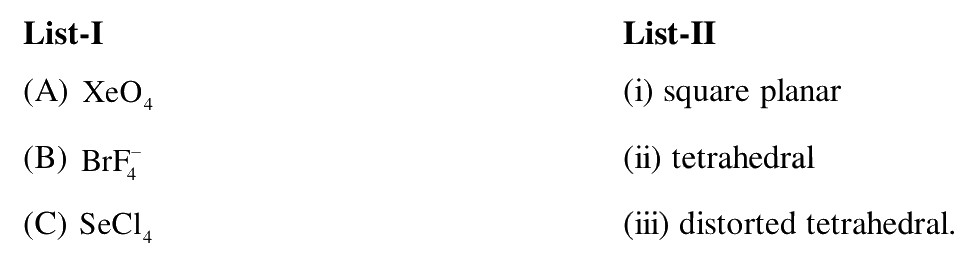
Match list I (compounds) with list II (structures), and select the correct answer using the codes given below.
\begin{tabular}{ll}
\textbf{List-I} & \textbf{List-II} \\
(A) $\text{XeO}_4$ & (i) square planar \\
(B) $\text{BrF}_4^-$ & (ii) tetrahedral \\
(C) $\text{SeCl}_4$ & (iii) distorted tetrahedral
\end{tabular}
a.
(A-ii) (B-iii) (C-i)
b.
(A-iii) (B-i) (C-ii)
c.
(A-ii) (B-i) (C-iii)
d.
(A-i) (B-ii) (C-iii)
Correct Answer & Step-by-Step Solution Locked
Sign in free to reveal the correct answer and AI explanation for this question.
In the $\text{trans-PtCl}_2\text{L(CO)}$ complex, the CO stretching frequency for $\text{L} = \text{NH}_3$, $\text{pyridine}$, $\text{NMe}_3$ decreases in the order.
a.
$\text{pyridine} > \text{NH}_3 > \text{NMe}_3$
b.
$\text{NH}_3 > \text{pyridine} > \text{NMe}_3$
c.
$\text{NMe}_3 > \text{NH}_3 > \text{pyridine}$
d.
$\text{pyridine} > \text{NMe}_3 > \text{NH}_3$
Correct Answer & Step-by-Step Solution Locked
Sign in free to reveal the correct answer and AI explanation for this question.
In $^{57}\text{Fe}^*$ Mossbauer experiment, source of $14.4\text{ keV}$ (equivalent to $3.48\times 10^{12}\text{ MHz}$) is moved towards absorber at a velocity of $2.2\text{ mm s}^{-1}$. The shift in frequency of the source for this sample is:
a.
$35.5\text{ MHz}$
b.
$25.5\text{ MHz}$
c.
$20.2\text{ MHz}$
d.
$15.5\text{ MHz}$
Correct Answer & Step-by-Step Solution Locked
Sign in free to reveal the correct answer and AI explanation for this question.
For the following outer sphere electron transfer reactions.
$$[\text{Co}(\text{NH}_3)_6]^{2+} + [\text{Co}^*(\text{NH}_3)_6]^{3+} \rightarrow [\text{Co}(\text{NH}_3)_6]^{3+} + [\text{Co}^*(\text{NH}_3)_6]^{2+}$$
$$[\text{Ru}(\text{NH}_3)_6]^{2+} + [\text{Ru}^*(\text{NH}_3)_6]^{3+} \rightarrow [\text{Ru}(\text{NH}_3)_6]^{3+} + [\text{Ru}^*(\text{NH}_3)_6]^{2+}$$
the rate constants are $10^{-6}\text{ M}^{-1}\text{ s}^{-1}$ and $8.2\times 10^2\text{ M}^{-1}\text{s}^{-1}$ respectively. This difference in the rate constants is due to
a.
A change from high spin to low spin in Co* and high spin to low spin in Ru.
b.
A change from high spin to low spin in Co* and low spin to high spin Ru*.
c.
A change from low spin to high spin in Co* and the low spin state remains unchanged in Ru.
d.
A change from low spin to high spin in Co* and high spin to low spin in Ru*.
Correct Answer & Step-by-Step Solution Locked
Sign in free to reveal the correct answer and AI explanation for this question.
The greater stability of $((\text{CH}_3)_3\text{C}-\text{CH}_2-)_4\text{Ti} \text{ (A)}$ compared to that of $((\text{CH}_3)_2\text{CH}-\text{CH}_2-)_4\text{Ti} \text{ (B)}$ is due to
a.
Hyperconjugation present in complex (A)
b.
$\beta$-hydride elimination is not possible in complex (A)
c.
Steric protection of titanium from reactive species in complex (A)
d.
The stronger nature of Ti–C bond in complex (A).
Correct Answer & Step-by-Step Solution Locked
Sign in free to reveal the correct answer and AI explanation for this question.
A compound $\mathbf{A}$ having the composition $\text{FeC}_9\text{H}_8\text{O}_3$ shows one signal at $2.5\text{ ppm}$ and another one around $5.0\text{ ppm}$ in its $^{1}\text{H NMR}$ spectrum. The IR spectrum of this compound shows two bands around and $1680\text{ cm}^{-1}$. The compound follows the 18 electron rule of the following statements for A, the correct one is/are
(A) It has $\eta^5-\text{Cp}$ group.
(B) It has a terminal $\text{CO}$ ligand.
(C) It has a $\text{CH}_3$ ligand
(D) It has $\text{Fe}-\text{H}$ bond.
a.
(A) and (B) only
b.
(C) only
c.
(A) and (C) only
d.
(B) and (D) only.
Correct Answer & Step-by-Step Solution Locked
Sign in free to reveal the correct answer and AI explanation for this question.
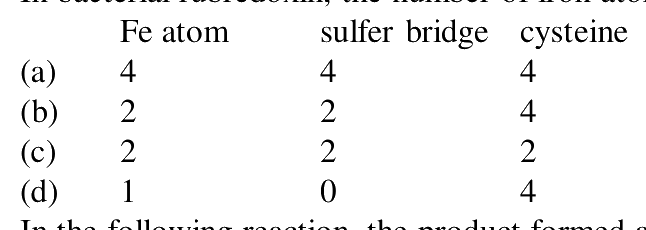
In bacterial rubredoxin, the number of iron atoms, sulfur bridges and cysteine ligands are, respectively:
$$\begin{array}{lccc} & \text{Fe atom} & \text{sulfur bridge} & \text{cysteine} \end{array}$$
a.
$4, \quad 4, \quad 4$
b.
$2, \quad 2, \quad 4$
c.
$2, \quad 2, \quad 2$
d.
$1, \quad 0, \quad 4$
Correct Answer & Step-by-Step Solution Locked
Sign in free to reveal the correct answer and AI explanation for this question.
An optically active compound enriched with R-enantiomer ($60\%\text{ ee}$) exhibited $[\alpha]_\text{D} +90^\circ$. If the $[\alpha]_\text{D}$ value of the sample is $-135^\circ$, the ratio of R and S enantiomers would be
a.
$\text{R}:\text{S} = 1:19$
b.
$\text{R}:\text{S} = 19:1$
c.
$\text{R}:\text{S} = 1:9$
d.
$\text{R}:\text{S} = 9:1$
Correct Answer & Step-by-Step Solution Locked
Sign in free to reveal the correct answer and AI explanation for this question.
Statement I. $\text{U(VI)}$ is more stable than $\text{Nd(VI)}$.
Statement II. The valence electrons in $\text{U}$ are in $5\text{f}$, $6\text{d}$ and $7\text{s}$ orbitals.
a.
Statements I and II are correct and Statement II is correct explanation of I.
b.
Statements I and II are correct but Statement II is not an explanation for Statement I.
c.
Statements I is correct and Statement II is incorrect.
d.
Statements I and II both are incorrect.
Correct Answer & Step-by-Step Solution Locked
Sign in free to reveal the correct answer and AI explanation for this question.
Reaction of $11.6\text{ g}$ of the aldehyde A with $462\text{ mg}$ of Wilkinson's catalyst provided $9.2\text{ g}$ of alkene B. The mol % of the catalyst used and the yield of the reaction, approximately are
a.
$1.0\text{ mol}\%$; and $80\%$
b.
$1.0\text{ mol }\%$; and $90\%$
c.
$0.1\text{ mol}\%$; and $90\%$
d.
$0.2\text{ mol }\%$; and $80\%$
Correct Answer & Step-by-Step Solution Locked
Sign in free to reveal the correct answer and AI explanation for this question.
Citronellol A on oxidation with pyridinium chlorochromate (PCC) followed by treatment with aq. sodium hydroxide gives the product B (IR : $1680\text{ cm}^{-1}$); whereas oxidation with PCC in the presence of sodium acetate gives product C (IR: $1720\text{ cm}^{-1}$). Compound B and C are
a.
B and C as shown in (a)
b.
B and C as shown in (b)
c.
B and C as shown in (c)
d.
B and C as shown in (d)
Correct Answer & Step-by-Step Solution Locked
Sign in free to reveal the correct answer and AI explanation for this question.